
From Business Payments to Financial Statements
From Business Payments to Financial Statements, FiChecks helps businesses organize payment records and supporting financial data in one place. Track check payments, ACH transactions, vendor payments, expenses, and transaction history to support accurate financial reporting and easier payment reconciliation.
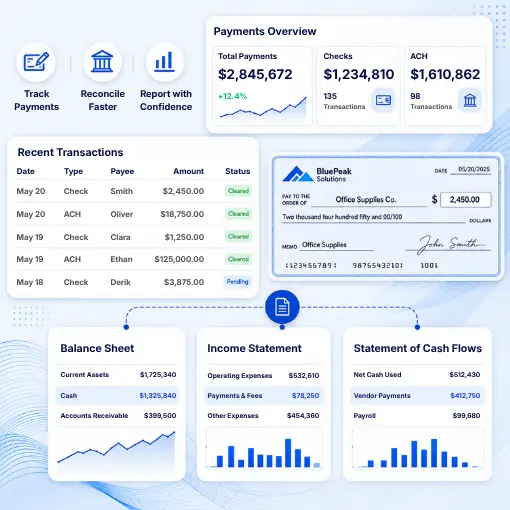
Secure Payment Processing
Automated Payment Tracking
Centralized Financial Records
Web & Mobile Access
WHEN PAYMENT DATA GETS DISCONNECTED
Financial Records Can Become Difficult to Manage
Businesses process payments across departments, vendors, customers, and accounts. When payment information is spread across different systems, keeping financial records complete and accurate can take more time.
No. 1
Missing Payment Records
Scattered check payment records, ACH payment tracking, and vendor transactions can make it harder to maintain complete accounting transaction records.
No. 2
Manual Reconciliation
Teams may need to compare payment transaction history with bank records, invoices, and accounting data to identify missing or unmatched transactions.
No. 3
Limited Payment Visibility
Without a centralized payment audit trail, it can be difficult to review outgoing payments, vendor activity, and payment documentation.
No. 4
Time-Consuming Financial Reporting
Preparing financial reports becomes easier when payment data is organized and accessible throughout the financial reporting process.
A BETTER WAY TO ORGANIZE PAYMENT DATA
Connect Business Payments With Financial Recordkeeping
FiChecks helps businesses maintain organized payment information that can support financial reporting, reconciliation, and accounting workflows.

Create
Enter payment details, recipient information, amounts, and payment methods.

Approve
Use user permissions and approval workflows to maintain control over outgoing payments.

Send
Process payments through available methods, including checks and ACH transfers.

Track
Review payment transaction history, delivery status, and payment activity.

Record
Maintain payment documentation and transaction records for accounting and reporting needs.
PAYMENT DATA FOR BETTER FINANCIAL REPORTING
Everything You Need to Maintain Organized Financial Records
FiChecks gives businesses payment tools that help support accurate financial records and easier financial reporting.
Check Payment Records
Create, print, email, or mail checks while keeping payment information organized for future reference.
ACH Payment Tracking
Track ACH transactions and maintain payment records that can support reconciliation and accounting processes.
Vendor Payment Tracking
Manage outgoing payments to vendors, contractors, and service providers while maintaining transaction history.
Business Expense Tracking
Keep payment information organized to support expense reconciliation and business expense tracking.
Payment Transaction History
Access payment activity and transaction details from a centralized platform.
Payment Audit Trail
Maintain visibility into payment activity, approvals, and transaction records for easier review.
BUILT AROUND YOUR FINANCIAL WORKFLOW
Support Financial Reporting With Better Payment Records
Businesses can use organized payment information to support a range of accounting and financial management activities.
Maintain business payment records for accounting purposes
Support bank transaction reconciliation
Track outgoing payments across departments
Maintain check and ACH transaction history
Support accounts payable management
Organize payment documentation
Improve financial recordkeeping
Financial Statements for Different Business Needs
Financial information can be used for internal reporting, accounting, budgeting, planning, audits, and business decision-making.
Business Financial Statements
Personal Financial Statements
Financial Statement Analysis
Frequently Asked Questions
What are financial statements and what do they show?
Financial statements are formal records that summarize a business's financial position, performance, and activity. Common examples include the balance sheet and income statement. FiChecks helps businesses organize payment transaction history and financial records that can support their accounting and reporting processes.
What is the difference between a balance sheet and an income statement?
A balance sheet shows a business's assets, liabilities, and equity at a specific point in time. An income statement shows revenue, expenses, and profit or loss over a period. FiChecks helps businesses maintain organized payment records that can support the financial reporting process.
How can businesses keep payment records organized for financial reporting?
Businesses can centralize check payments, ACH transactions, vendor payments, transaction history, and payment documentation to make reconciliation and reporting easier. FiChecks provides payment management tools that help businesses maintain organized records and improve visibility into payment activity.
Financial Statements vs Payment Records
Financial statements summarize a business's financial position, performance, and activity, while payment records provide transaction-level details behind many of those figures. FiChecks does not replace accounting software or prepare a company's financial statements. Instead, it helps organize business payment records, check transactions, ACH activity, vendor payments, and payment documentation that businesses can use alongside their accounting and financial reporting processes.